Indonesia Recovers Suspected Chinese Underwater Drone In Lombok Strait
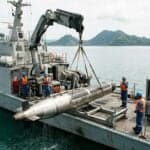


An Indonesian fisherman has recovered a suspected Chinese underwater drone from waters near the Lombok Strait.
The device was found in early April, on April 6 at around 10:00 WITA, north of Gili Trawangan while the fisherman was out at sea.
A normal fishing activity turned into a security concern after the metallic object was pulled from the water and authorities were informed.
Police and naval personnel later secured the device from the beach and moved it to the Indonesian Navy’s base in Mataram for further checks.
Officers initially treated the site carefully but later confirmed there were no explosives or radioactive materials inside. Officials described it as a marine technology system and said detailed examination would follow.
The object is cylindrical and torpedo-shaped, measuring about 3.7 metres in length and around 0.7 metres in diameter. It has rear fins and sections that appear to contain sensors, which are commonly seen in unmanned underwater vehicles.
The hull carries the “CSIC” marking along with Chinese characters reading “中国船舶集团,” linking it to China’s state-owned shipbuilding and defence industry.
The company is now part of China State Shipbuilding Corporation, one of the world’s largest shipbuilding groups.
The drone was found roughly 10 to 16 kilometres inside the northern Lombok Strait, within Indonesia’s Archipelagic Sea Lane II (ALKI II).
This route is a recognised international passage and is closely watched because it connects the Pacific and Indian Oceans.
It is one of the few deepwater channels in the region that allows submarines and large naval vessels to pass at operational depth without using shallower routes.
Authorities said the device appears to be used for observation or underwater survey work.
Experts note that such systems can collect data on seabed conditions, currents, temperature, salinity and underwater sound. While this information is often used for research, it can also support submarine movement in strategic waters.
Marine growth, including barnacles, was found on the surface of the device, suggesting it had been in the water for a long time before being recovered.
Officials are now working to determine how long it had been deployed and whether it still contains any stored data.
This is not the first time such equipment has been found in the region. In December 2020, fishermen near Selayar Island recovered a Sea Wing (Haiyi) underwater glider.
Similar devices were also found earlier near the Masalembu Islands in the East Java Sea and near the Riau Islands close to the Strait of Malacca. Those units were linked to Chinese research bodies, including the Shenyang Institute of Automation.
Similar recoveries have also been reported in the Philippines between 2022 and 2024, including near Calayan Island and Masbate Province. Those drones were fitted with sensors used to monitor underwater conditions and map the seabed in important sea lanes.
China has expanded the use of such underwater systems over the years.
Sea Wing gliders developed under the Chinese Academy of Sciences are designed to travel long distances by adjusting buoyancy and moving slowly through the water.
They can remain at sea for long periods and collect large amounts of ocean data before sending it back.
Per reports, a group of these gliders was deployed in the Indian Ocean in 2019, gathering thousands of ocean observations during that mission.
Such systems are now seen as part of a network used to collect environmental data across key maritime routes.
Indonesian authorities said a full technical assessment is ongoing at the Mataram naval base to confirm the origin of the device, its purpose and whether it was being used for research, mapping or another type of operation. No official response has been issued by China so far.
References: interestingengineering, defencesecurityasia
Want to read more?
Check out the full article on the original site